Showing posts with label taffeta. Show all posts

Saturday, February 26, 2011

14 DTG-The Skirt, Taffeta

Now that I know that the lining layer is as full as I was envisioning and works with the petticoat, it's onto the taffeta layer.  It's essentially constructed the same way the lining layer was, from the same pattern pieces.


Under Layer (Outer Layer of the Stay) - Taffeta
  • 10 - Waistband (only 1 cut from material, cut second one from interfacing)
  • 11 - Side stay (cut twice to equal 4 total pieces)
  • 12 - Front stay
  • 13 - Back stay
I've laid out, but not cut, pieces 12 and 13.  I'll start with them first, so that all I'll have left are 2 sets of piece 11 which I'll need to refold the remaining material in the other direction.


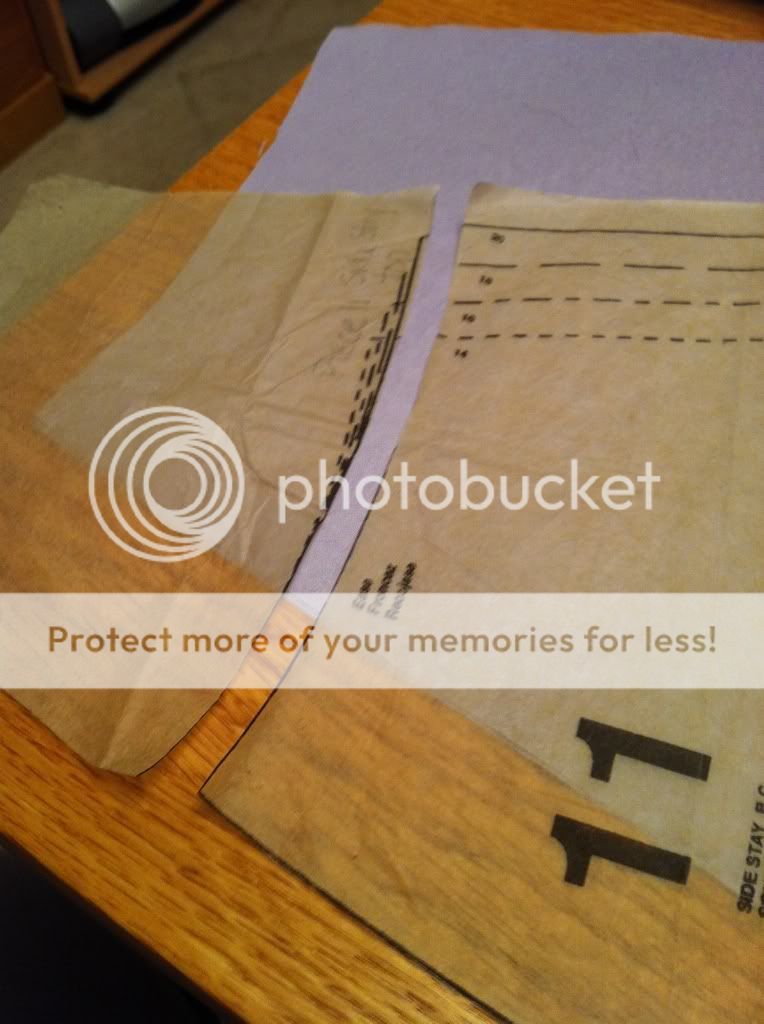
Piece 13 cut out of taffeta. You can see the extrapolation
to add length to the bottom compared to the pattern.


Transferring markings from the pattern to the material


I use a pin through the layers to transfer markings to the bottom layer of fabric


Piece 12, Notice my ironing board in the foreground,
the bolt of remaining fabric across the arms of the chair
in the background and the taped instruction sheets to
the bookshelf for easy reference.


Second set of piece 11.  There's a lot of extra yardage draping off the table on the left.


Once I'm done with these pattern pieces, I'm finished with them, so I can put them away.  There was a section of piece 11 for the other sizes that had been cut off when cutting out material.  I had labeled it in case it got lost floating around, but I reattach it now.


I like to fold my garment pieces together, so they come out as a complete packet if I ever need to use them again.  Then they go back into the pattern envelope.  I'll have to blog sometime on my organization methods, probably when I detail my dream craft room and what I have now.


The last piece I need is a single cut of piece 10 for the skirt waistband, which I take from a left over margin.


Then it's onto assembly!  I'm finally feeling more excited about the outcome of this project than I am stressed about the lack of time to finish it.  I think, since being at the TWO WEEK TO GO mark, the excitement about the trip in general is starting to kick in.  :-)


Just like cutting out the pieces for the taffeta were nearly identical to cutting them for the lining, so is assembly of this layer.

  • Stitch together front half:  11 - 12 - 11
  • Stitch together back center sections 13 - 13 up to large circle, leaving above this mark open.  This will be where the zipper runs.  Clip seam allowance to large circle.
  • Stitch remainder of back half:  11 - 13 - 13 - 11
  • Stitch front and back halves together to create circle.


To Do List
  • Seam allowances of lining and taffeta
  • Figure pockets
  • Join lining and taffeta
    • zipper
    • waistband
    • hem (horse hair)
  • Cut pieces from organdy
  • Assemble organdy layer
  • Finish skirt details

Wednesday, February 23, 2011

21 DTG-The Real Thing, Continued

Started out today by stitching all the taffeta underlined pieces together, using Light Violet thread on both the top and bobbin.


Middle front pieces joined to center front
Notice all the thread ends that I need to keep track of
so I can remove the appropriate basting strands


Then I concentrated on piece 8.  Remember, this is the back band that the grommets will be punched through.  To reinforce these pieces, they aren't underlined like the other taffeta pieces of the garment.  These are the pieces that were cut from fusible interfacing, which has a heat/water activated glue built into it which secure it to the underside of the taffeta.  The "glue" side looks metallic, so I have to be sure and face this to the taffeta.  I learned the hard way about 10 years ago, that this stuff is NASTY when it sticks to the plate of my iron.


To join the pieces together, the instructions recommend placing a damp cloth over it and placing a high heat iron on top of them for 10 seconds.  I'm sure this is meant to leach the water from the cloth into the interfacing, but I have a very nice, very powerful steam iron, which works just as efficiently.  I just need to be sure and leave it on each second for long enough for fusion to occur.  Trial and error indicated 15 seconds and about 3 puffs of steam do the trick.


Pieces 8 with interfacing fused to them


I folded the pieces lengthwise and stitched across the upper and lower edges
Then I trimmed the seam allowances down to about 1/4", inverted the pieces so the right sides showed (using the technique with the skewer to turn out the corners as discussed when I made the mock up), and pressed the folded edge.


Then I based the raw edges together.  Again, I should have
used a contrasting thread color to not waste my Lavender Bliss
and to make the threads that I need to later remove, stand out


I pinned the piece 8 to the back edge, matching up
the alignment dots that had been transferred from the pattern,
then stitched the pieces down
(Lavender Bliss on top, Light Violet on bobbin)


I started to stitch the lining pieces together (using Light Violet on both the top and bobbin) when I ran into a HUGE problem.  Remember when I did Ashley's Alterations and I ended up hand stitching everything because the charmeuse was snagging when I used the machine?  Well, I ran into the same problem again with the very thin material of the lining.  It puckered horribly and started pulling runs across the fabric.


This usually indicates a dull needle or one that isn't fine enough for the type of fabric.  But I am using a brand new, size 11 needle.  Internet research gave me a few suggestions to try, but it'll required a trip to Hancock's tomorrow before I can move on.

  • an even thinner, Martex type, needle in size 70/9
  • specific thread made for silk fabrics (because it's finer)
  • increase the stitch size
  • use tissue paper as either backing or between the layers to provide a type of stabilizer that I would rip away after the seams are sewn


To Do List
  • Buy finer needles and silk thread
  • Test out some of the suggested techniques to find something that works for the lining
  • Stitch all lining layer pieces together
  • Stitch down seam allowances on lining
  • Bind seam allowances of taffeta layer
  • Stitch layers together
  • Send off to mom

22 DTG-Petticoat & The Real Thing

My petticoat came in yesterday, but I didn't have a chance to try it on!


It came all petite-ly packaged, encouraging for transport


I carefully took note of how it was folded up, but it came with a step-by-step instruction sheet detailing how to get it back in its collapsed condition.


I LOVE how full it is, especially that the tulle layers hide the
"hoop look" giving extra fullness


Starting Construction


Although the Vogue pattern that I am using for the corset top doesn't call for underlining, the construction of the McCall's top that originally came with the dress, did call for one.  So taking the best practices from each top (since I merged some of both patterns, mostly relying on the Vogue pieces), I had cut two sets of lining for a lining and underlining.


I purchased 2 different colors of thread, based on best coloring matching of the various materials (taffeta, organdy, and lining).  And how I sew through the various steps can be determined by which threads I'm using in which positions (the top spool and the bobbin from underneath the machine).


  • Coats and Clark Dual Duty XP 250 yds All Purpose 3620-Lavender Bliss (color matches taffeta)
  • Coats and Clark Dual Duty XP 250 yds All Purpose 3340-Light Violet (color matches lining)

I baste together a piece of underlining on the "wrong" side of each piece of taffeta.  Basting stitches are longer because they are made to temporarily hold together 2 pieces until permanent seams are put in and are usually ripped out later.  I use 6 for basting (the longest setting on my machine) versus 10-12 for regular seams.

I kinda messed up because I forgot about the color switch trick for basting.  Instead of "wasting" some of the good, color matched threads for basting (because they're just going to get ripped out and thrown away later), I like to use black or white bulk thread.  The bulk thread is cheaper and is usually generic quality.  And by using a contrasting color to those that match the fabrics, it's easy to see what I need to make sure and later remove.

Instead, to baste, I used Lavender Bliss on the top and Light Violet on the bobbin, matching each thread to it's appropriate material side.

Underlining (seen on the turned up piece) basted to taffeta pieces 

The pattern calls for certain places of the pieces to be reinforced by "staystitching" on the edges.  Staystitching is a line of straight stitches, smaller than basting, usually about the same stitch length as what you use for seams.  Smaller stitch lengths are harder to unravel if something should pop and harder to pop if the seams strain.  In other words, smaller stitches equal a stronger garment.  Staystitching, occurs about an 1/8" from the seam (which is at 5/8" so I staystitch at 1/2"), and is used on seams that curve (such as at the bust) because this is where more strain will be placed on the garment.  On my garment, staystiching is called from between the 2 match up arrows on the sides of the front center piece (right where the bust will curve outward to accommodate Da Girls) and along the curve of the sweetheart neckline.

Staystitching between the 2 match up arrows on
sides of front center piece

To Do List
  • Stitch all pieces together
  • Stitch all lining layer pieces together
  • Stitch down seam allowances on lining
  • Stitch layers together
  • Send off to mom

Thursday, February 17, 2011

24 DTG-Cutting Material

From the lining material, I've cut both the underlining and the lining for all the pieces of the corset top.


I left the pattern papers pinned to the second set of linings (2 of each piece)
and there's a set (2 more of each piece) that you can see in lavender.
Remember, there's 4 pieces cut for each pattern
(for a right and left side of the garment, both lining and underlining layers)
except the middle which is folded in half


I also cut lining for a few skirt pieces, but I've set the rest of the skirt and lining aside for now because I NEED to concentrate on the corset to get. It. Off. To. My. Mom!!!!!!  %&*#!!!  I am super feeling the pressure from the time clock.


Real quick, I knocked out what I need cut from the fusible interfacing.  I need 1 piece 10 from the skirt (waistband) and 2 piece 8 from the corset (back band - remember the fusing reinforces these pieces that the grommets will pierce).  


It was much easier to cut these pieces because I don't have yards and yards to manage of the interfacing like I do the taffeta.  My lack of an actual cutting table is frustrating at times like these.  My dining room table (4x6) with a chair on one end and the ironing board on the other end to lengthen the surface area and catch the overhang of yardage is cumbersome, but it works.  For now.


Now onto cutting the pieces I need from the taffeta, utilizing the same layout technique that I used for the lining.  I only need one set of all the corset pattern pieces from this material.  And the same pieces for the skirt as I cut on the lining, plus a piece 10.  But again, only going to cut what I need to of the skirt to determine where I need to take my corset pieces from and leave the rest of the skirt until later.


Here you can see each individual piece laid out carefully with
"right sides" up and in the order I need to sew them together


Taffeta doesn't really have a "right side/wrong side" to it.  But I'm a-type enough to want to keep track.  My thinking being that the "underside" of the fabric (the inside of the material when it's folded in half on the bolt) has been treated differently in processing, packaging and shipping than the "outer side" of the material which is exposed.  In case any slight variations exist that I can't see now, but may show as the fabric ages or is worn and then cleaned, I like to track the sides.  And since they look the same to me now, it takes some careful planning and purposeful intention with how I place my fabric now.  Hence the reason I unfolded and laid out the pieces, right side up as shown above.


For instance, piece 8 has not only match up arrows to be cut out of the sides, but also has match up circles on the interior of the piece.  They're best marked with a washable pencil on the "underside" (or wrong side) of the fabric so that in the course of sewing, they won't show on the garment.  I marked on the muslin with regular pencil without care about anything showing because ease saves time and the point of the muslin was to quickly assess pattern fit.


See the difference in how I cut notches into the edge for the arrows
on the pattern versus how I marked where the circles are


To Do List


  • Embroidery
    • communicate with mom
    • order pattern off internet
    • get supplies she needs
  • Begin The Real Thing assembly (cause need to get it off to mom in the mail!)
  • Browse/shop Michael's for beads and embellishments
  • Browse/shop for ribbon to lace up back - appropriate color and thickness

Thursday, January 13, 2011

Project: NashCon Ball Gown

So the main point of the blog is to chronicle my projects, so let's start with the major one that I acutely begin today.  In exactly 8 weeks, I'll be departing for Nashville, TN to join my newest, dear group of friends for a Twilight Convention.  I went to one last year and met up with many of the same gals for that one.  For the ball, hosted on Saturday night, I wore a 2-piece Scott McClintock I'd had in my closet for years.  But I joined the planning for that convention a mere 6 weeks before it even happened.  I've been planning on this year's convention since last year, thus I've had a lot of time for ball gown ideas to ruminate.


Being the princess I like to think myself, I wanted to go pretty, long, formal, and utterly me...IOW custom made.  Left-brain process began months ago, but also told me to wait until after Christmas to purchase my supplies and direct my time toward the gown.  I kept coming back to the same look when I flipped through gowns and saved pictures I liked:


Which easy enough lends itself pretty closely to McCall's pattern 5321:


Pattern-Vision Differences

The back closure of the pattern calls for bridal loops and buttons, a PITA to get into compared to the lace-up style that was on the inspiration dress.  And I feel like lace up would give me a more corsetted, held-in, exact garment feel.  But I have reservations (based upon experience with my bridal gown) about sewing in loops sturdy enough to lace up that would actually bind in my very large chest.  Vogue pattern 2810 has a corset top that is eyelet grommeted though, so even though more expensive ($3.99 on sale) I bought it, hoping it'll give me some inspiration or tips to experiment with the grommets. If not, there's always the internet as a source of advice and trial and error on my inevitable mock up.

I learned from my mother that when altering a pattern, especially for a formal gown (which uses more expensive materials), it's always best to play on a muslin mock up.  My rib/waist measurement and my bust have been in quite the size disparity for some time now, so I know I'm going to need to play with combining the 2 different pattern sizes for the top fit and look that I want.  I'll use that mock up to learn how to use grommets as well.

The skirt is gathered/poofed in more places on the vision dress than on the pattern (3 and 2 spots per line instead of the 2 & 1 spots per line).  That'll be easy to play with and add as long as I allow more length.  Something I usually need to do anyway since I'm taller than most patterns fit.  So I'll need to buy more yardage and more buttons or jewels than the pattern calls for to attach in those places.

The vision dress is also, obviously gathered with a sheer material instead of the solid the pattern calls for.  Pattern dress calls for enough lining fabric to make the inner skirt that the billows are attached to (called a Stay on the pattern, in essence it's a skirt that's more A-line and not as full as the top skirt piece) AND an exact replica cut of the billowed layer.  So 3 layers:
L1-outside billowed skirt layer
L2-lining of billowed skirt layer
L3-Stay (straighter lined skirt that billowed skirt is attached to)

To achieve vision dress, I need L1 in sheer material, L2 in "real" material (the stuff that matches what will show on corset top), and L3 in lining.  This poses a few dilemmas.  Pattern dress has the wrong side of L2 facing the wrong side of L1.  But if my L1 is sheer, you're now going to see the exposed seams of L2, so I've got to reverse the way L2 is facing.  And my L2 now needs to be not as full so that I have something to gather the sheer layer onto.  I really need to cut L2 out of "real" material but to the same shape as the lining material.  So I've got to play with how much to buy of each.

I'm going to add pockets on the side seams (easy enough to do to ANY dress), because who can't use pockets instead of lugging around a purse when you want to be footloose and fancy free?

To encourage fullness, I'm still contemplating sewing increasing layers of bulk tulle into the lining (onto L3 under L2), but I'll need to retain a little more fullness in L2 to allow for it to bulk the gown.  This adjustment to L2 might be more trouble than a "petticoated" dress is worth, but I'll decide later as I play with it.

I'm still optimistic that this hasn't gotten too complicated yet.

Color & Material

I decided to go either gray or lavender, but couldn't decide on color.  I wanted something other that satin because it tends to be heavy and weigh itself down.  So I was looking for something lighter, maybe stiffer, to "sit up" on its own and give me the fullness I wanted. 

And some searching of Joanne's and Hancock's yielded some material possibilities.  Hancock's bff line (which carries matching materials, lace, sheers and lining) had a shade in each color that caught my eye and I liked the feel of the taffeta.  There were also plain sheer organdy or a more glittery organza or a type of sequined organdy to chose from for the overlayer.


While most people told me they liked the gray, the lilac is my favorite color, so I couldn't decide.  I contemplated trying to work in both colors.  Sheer layer in one color while the rest of the dress is in the other.  A bust band in the opposite color.  Layering the bust with a peekaboo of the opposite color.  But it came down to what had enough in stock to be bought.

I waited to buy the fabric until the MLK weekend sale started because the patterns went 5/$5 (compared to $16 a piece!  NEVER EVER buy patterns for more than a few dollars unless it's discontinued and you can't find it anymore.  Sales for $1 or $1.99 a piece are common on major holiday weekend sales.)  Buttons were also 50% off and trims were 40-50% off.  And surprise, surprise, the bff collection was 30% off!

At the cutting table, the pewter was 6 yds shy of what I needed and a call to the other store in town and the one in Cinci (I'd be up there to pick up my parents from the airport next week), still didn't yield big enough pieces that the large skirt requires.  But there was plenty of lilac.  Which honestly doesn't hurt my feelings because I can work the silver in plenty of other ways - the embellishments or buttons that tuck up the skirt billows, a wrap, my shoes (which I already found are silver satin peeptoes), and the corset embellishments.  Which brings up a whole. Nuther. Issue.

Corset Embellishments

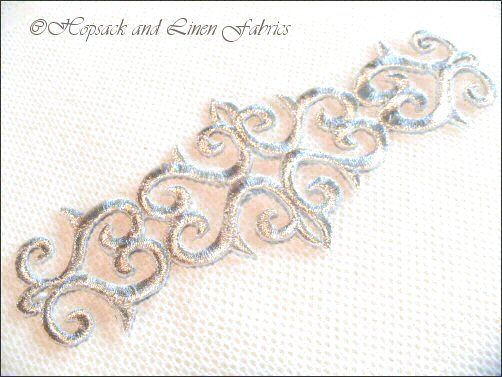
It dawned on me late last night that one of the huge attractions to vision gown are the silver scroll embellishments on the corset.  I have a fixation with anything french scroll-looking, so no wonder.  The question is how to duplicate it and if it's worth it.  I spent some time researching appliques, sequin embellishments, beaded embellishments, and embroidery.  There's a lot of white floral and white lace to be found out there, mostly in the field of bridal embellishments, but not a whole lot of silver unless you head into gaudy territory with all the sequining.  I found a piece on ebay that I ordered, but it's very simple and not dynamic.


I also found this, but haven't ordered it because it's white, not silver.  I'd have to find a way to paint or dye it.


I was contemplating hand stitching if I had enough time, but worry about asymmetry errors.  I wouldn't mind hand beading seed beads, but that's not the bulk of the pattern on vision dress. The ideas behind this are appealing to me as well:


Ultimately, the search turned up scroll embroidery patterns online for download to a sewing machine.  Which I do not have at the moment.  BUT, mom will be here next week and SHE has one.  I have an appointment to web chat with her tonight, see if the set of PERFECT french scroll patterns I found online are compatible with her machine and if she'd be willing to take the unfinished top home to embroider and mail it back to me.  This is all contingent upon getting a mock up that works perfectly, done while she's here and cutting the real pieces to send her home with.  If not, I'll probably look for beads and gems at Michael's to form a sort of central brooch like on the gray dress above.

The Shopping List
  • McCall's pattern 5321
  • Vogue pattern 2810
  • Lilac thread


Top
  • 1/2 yd 60" lilac bff taffeta
  • 1 1/8 yd 45" lilac bff lining
  • 2 yds 1/4" covered boning
  • 1/2 yd of 1/8" bridal loops (JIC my lessons in grommets don't work out)
  • 20 3/8" covered buttons (JIC grommets don't work)
  • Eyelet kit containing 25 grommets and tool
  • Ribbon (1/2" or wider?) (TBD)
  • Any special backing fabric to reinforce the material where the grommets are punched through (TBD)
  • Silver thread for mom to embroider with (TBD)
  • Other embroidery supplies (need to find out what kind of special backing or layer fabrics are needed) (TBD)
  • Embroidery patterns for download (TBD)
  • Beads/gems/seed beads to embroider by hand (TBD)
Skirt
  • 8 1/4 yds (minimum) 60" lilac bff shiny organdy
  • 8 1/4 yds (maximum) 60" lilac bff taffeta
  • Need to figure amount needed of 45" lilac bff lining (lay out pattern pieces for Stay and measure, make sure there's enough scraps to make 2 pockets)
  • 1 1/8 yds 22" sew-in interfacing
  • 7" lilac zipper
  • 2 half moon hook and eye closures
  • 7 1/4 yds (minimum) 1" horse hair braid
  • Decorative buttons/rhinestones (25-30)
Shopping

I got everything that isn't TBD on my list except lining today (because they didn't have enough and I don't have an exact figure calculated).  I hope to pick that up at a Cinci store on Tuesday when I'm up there.  I found 1/4" rhinestone buttons and some 7/16" translucent lilac buttons to mix and scatter at the overskirt pull up locations.  And I purchased 8 yds of silver metallic organdy that was in the clearance bin.  I might use it to accordion fold and gather under the bust line (you can see the effect I'm talking about in the back view of vision dress at the very top) and/or as a wrap.  

To Do List
  • Lay out pattern pieces and iron
  • Calculate the lining I need
  • Talk to mom about embroidery
  • How to use grommets research
  • Cut muslin corset top mock up pieces
  • Browse shop Michael's for beads
  • Research built in petticoat techniques