Saturday, February 26, 2011

14 DTG-The Skirt, Taffeta

Now that I know that the lining layer is as full as I was envisioning and works with the petticoat, it's onto the taffeta layer.  It's essentially constructed the same way the lining layer was, from the same pattern pieces.


Under Layer (Outer Layer of the Stay) - Taffeta
  • 10 - Waistband (only 1 cut from material, cut second one from interfacing)
  • 11 - Side stay (cut twice to equal 4 total pieces)
  • 12 - Front stay
  • 13 - Back stay
I've laid out, but not cut, pieces 12 and 13.  I'll start with them first, so that all I'll have left are 2 sets of piece 11 which I'll need to refold the remaining material in the other direction.


Piece 13 cut out of taffeta. You can see the extrapolation
to add length to the bottom compared to the pattern.


Transferring markings from the pattern to the material


I use a pin through the layers to transfer markings to the bottom layer of fabric


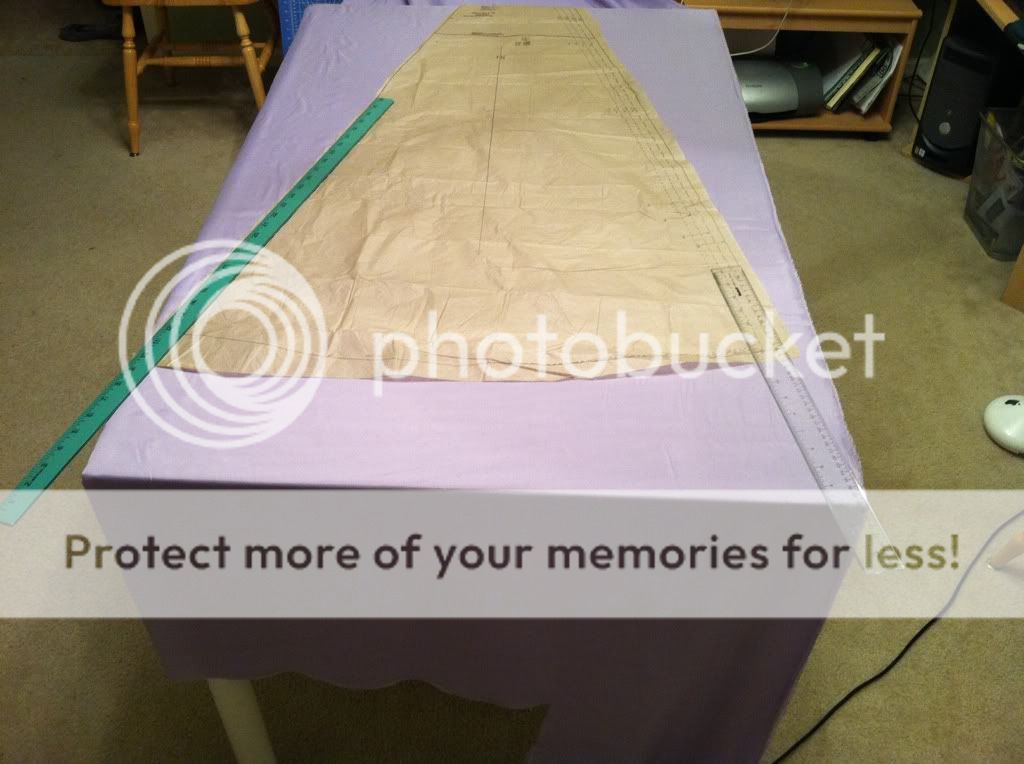
Piece 12, Notice my ironing board in the foreground,
the bolt of remaining fabric across the arms of the chair
in the background and the taped instruction sheets to
the bookshelf for easy reference.


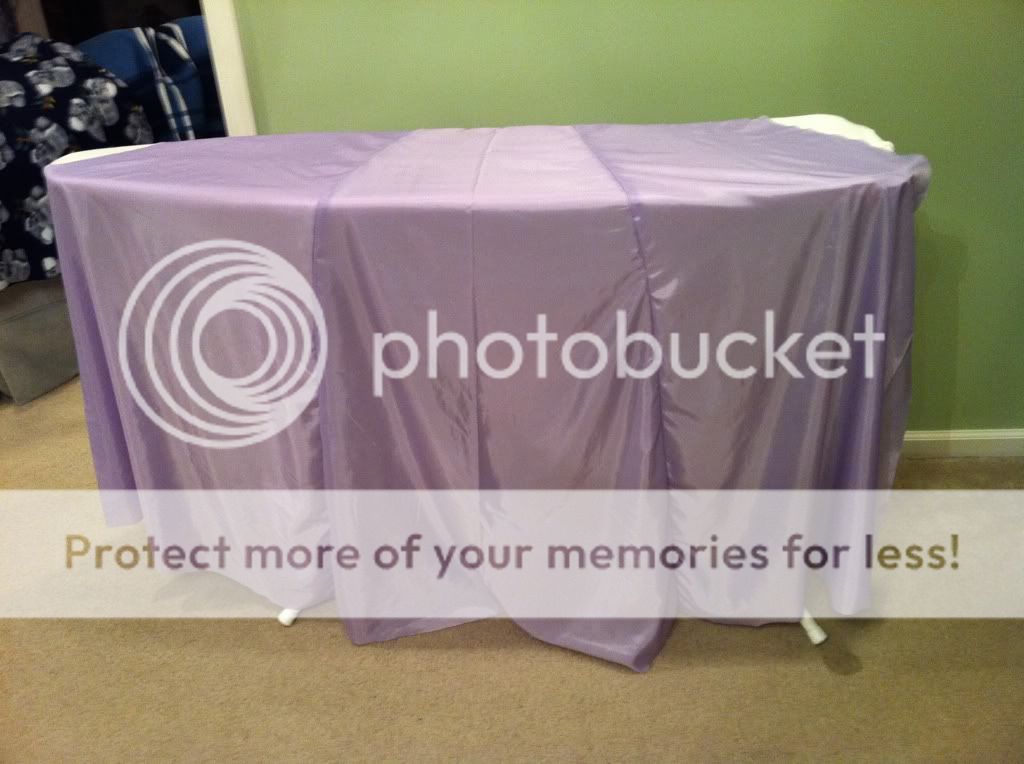
Second set of piece 11.  There's a lot of extra yardage draping off the table on the left.


Once I'm done with these pattern pieces, I'm finished with them, so I can put them away.  There was a section of piece 11 for the other sizes that had been cut off when cutting out material.  I had labeled it in case it got lost floating around, but I reattach it now.
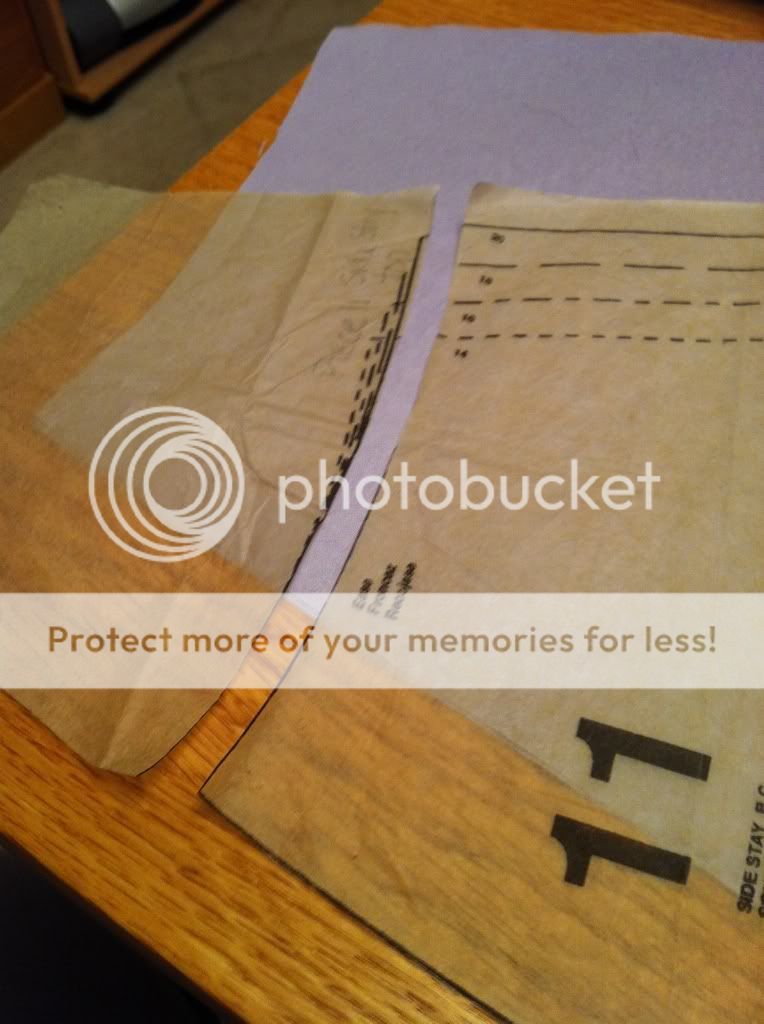


I like to fold my garment pieces together, so they come out as a complete packet if I ever need to use them again.  Then they go back into the pattern envelope.  I'll have to blog sometime on my organization methods, probably when I detail my dream craft room and what I have now.


The last piece I need is a single cut of piece 10 for the skirt waistband, which I take from a left over margin.


Then it's onto assembly!  I'm finally feeling more excited about the outcome of this project than I am stressed about the lack of time to finish it.  I think, since being at the TWO WEEK TO GO mark, the excitement about the trip in general is starting to kick in.  :-)


Just like cutting out the pieces for the taffeta were nearly identical to cutting them for the lining, so is assembly of this layer.

  • Stitch together front half:  11 - 12 - 11
  • Stitch together back center sections 13 - 13 up to large circle, leaving above this mark open.  This will be where the zipper runs.  Clip seam allowance to large circle.
  • Stitch remainder of back half:  11 - 13 - 13 - 11
  • Stitch front and back halves together to create circle.


To Do List
  • Seam allowances of lining and taffeta
  • Figure pockets
  • Join lining and taffeta
    • zipper
    • waistband
    • hem (horse hair)
  • Cut pieces from organdy
  • Assemble organdy layer
  • Finish skirt details
Friday, February 25, 2011

15 DTG-The Skirt, Lining

Let's review what pieces I'm working with for the skirt lining:


Lining Layer (Under Layer of the Stay) - Lining

  • 11 - Side stay (cut twice to equal 4 total pieces)
  • 12 - Front stay
  • 13 - Back stay

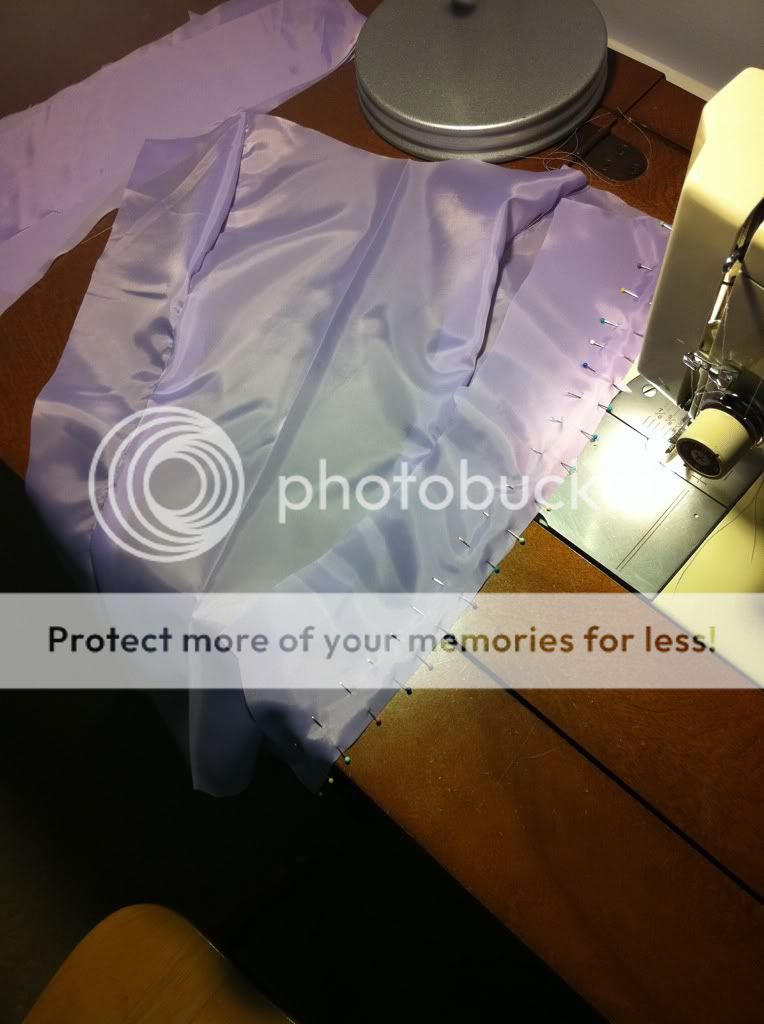
First, I stitch together pieces 11 - 12 - 11 to make the front half of the skirt.

Front half:  11 - 12 - 11


To make the back half, I stitch the 2 piece 13s up to the large circle.  The gap in the remainder of this seam is where the zipper will go later.


Next is joining the other set of piece 11s to the outsides of the joined pieces 13. 


I end up with 11 - 13 - 13 - 11


Now, I join the back to the front, essentially joining both piece 11s to the other set of piece 11s.  In the end I'll end up with a circle of:


11 - 12 - 11
/                \
11                11
\               /
13  -  13


I try this on for fit at the waist and over my petticoat to see if the angles of the skirt are full enough.

Assembled lining with my petticoat on

And I fall in love with my dress all over again!!  I'm so excited that it works and is coming together!

To Do List

  • Cut out rest of taffeta pieces
  • Assemble taffeta pieces
  • Join lining and taffeta
    • zipper
    • waistband
    • hem (horse hair)
  • Cut pieces from organdy
  • Assemble organdy layer
  • Finish skirt details

Thursday, February 24, 2011

16 DTG-The Skirt

So after spending ALL DAY yesterday researching machines and visiting a dealer here in town, I've learned that even if I order a machine today, it won't come in for another 6 weeks.  :-(  So unless my mom can get this embroidered, I'm going plain.


In the meantime, I'm onto the skirt.


I had started cutting some of the pieces in order to cut out the top pieces.  I already have piece 12 and 13 cut out of the lining.  I need to cut 2 piece 11s (for a total of 4 pieces).


Piece 11 is a little tricky though.  This is the only piece that has different size markings on it (kind of like pieces 4 and 7 on the top).  To cut out the size that I need, I need the widest bottom on the piece.  Then to expand this by another foot (remember I need additional length for all the reasons I detailed in this post), makes the bottom even wider.


Once I extrapolate the base of the skirt by 12"
(which is marked by the rulers) piece 11 is too wide
to fit on the fabric this way


To solve this, the pattern directions recommend folding the selvages the other way.  Refolding a HUGE piece of fabric like this is a major PITA and has me wishing - again - that I had a better set up than my kitchen table, office chair and ironing board.  LOL


Here's how I normally spread out the fabric.
When it's folded lengthwise, it's just as wide as my table.


Here's the fabric folded in half the other way.
Notice the fold line down the middle left
from when the fabric is folded to roll on a bolt.


I cut 2 sets of piece 11 from the refolded fabric by
inverting the pieces to minimize how much material is used.


To extrapolate the ends of the skirt pieces, I use my quilting tools.


Tomorrow, to make sure the skirt is full enough (both for my tastes and to fit over the petticoat), I'm going to assemble the lining layer before I cut out any more material from taffeta or get started on the organdy.

To Do List
  • Assemble lining layer
  • Cut out rest of taffeta pieces
  • Assemble taffeta pieces
  • Join lining and taffeta
    • zipper
    • waistband
    • hem (horse hair)
  • Cut pieces from organdy
  • Assemble organdy layer
  • Finish skirt details

18 DTG-Rethinking Some Things

Well, the USPS is working against me.  I had the mock up and the semi-finished top ready to overnight off to mom today.  I packed the kid in the car and took my visiting cousin with us, only to find out:  It's a holiday!  So the post is closed.  :-(  BLAST!!!


What's in the box


So if this can't go in the mail until tomorrow, my mom wouldn't get it until Wednesday, leaving her less than 2 weeks for her to get the embroidery done and get it back to me to finish.  Due to unknown travel plans and a few technology things that need to still be worked out with her machine, it very likely will be even less time than that.  So, knowing our tax money is coming in, that I'd discussed with my husband using toward a machine of my own, I'm going to hold onto the top and investigate some dealers in town and see where I end up.  


Worst case scenario, I don't embroider the top.  I just do some hand beading, leaving it mostly plain.  In the meantime, I need to get to crackin' on the skirt!

19 DTG-The Real Thing, Continued

I started today with a little iron work.  I pressed all the seam allowances of the taffeta layer toward the way the directions instruct.  Then did the same with the lining layer.


Just like the seam allowances of the taffeta, those of the lining are likely to fray as well (and are already displaying signs of doing such).  But remember, I need to actually topstitch the lining's seam allowances down to form the channels for the boning to run through.  My thought is to attempt to do both things at once, by using the zig-zag stitch through the seam allowance and the lining.  Yes, that means those zig-zags will show on the lining, but I can live with that.  And I think it's kinda decorative.


But since zig-zag stitching is denser (meaning the needle pierces the fabric more often) than just a straight line of stitches, I want to offer the material all the support I can.  So in this instance, I'm going to put tissue paper in between the seam allowance and the lining and sew through all of it.


The white tissue paper on the left, comes under the seam allowance
I'm sewing through all 4 layers (2 layers of seam allowance,
1 tissue paper and 1 of the lining underneath)


To make sure I leave 3/8"  of space for the channel,
I played with the stitch length of the zig-zag
A length of 3 and running the material with the seam allowance
edge just under the left edge of the foot lined everything up perfectly.


It's kind of complicated, especially on the curves to keep the tissue paper appropriately placed and to make sure everything lays flat against the under layer, but by taking it slow and readjusting often, it comes out in a way that I'm happy with!  


The tissue paper tears away easily-the stitching acts to perforate the paper


I also folded under the outer edges by 5/8" and pressed them, then applied the same technique to zig-zag stitch these edges down, creating 2 more channels for boning.  All this zig-zag stitching has used up all my Light Violet thread, so I need to get more.


With right sides together, I pinned the taffeta and lining layers together across the top only.  In the mock up I did both the top and bottom, but remember that I need to leave access to embroider the taffeta layer.  By stitching the 2 layers together, this will give my mom a finished top edge to embroider under.  


2 layers stitched together.  This is the wrong side of the lining side.


Before I flip the 2 layers so the right sides are out, I reinforced the curve of the sweetheart neckline.  Remember, this is one of the lessons I learned when I made the mock up that I said I'd elaborate on later.  Well, now is time for later.  I reinforce it the same way I reinforced the edges of the front center piece - by stitching another line 1/8" into the seam allowance.  This line of stitches looks lighter below because I ran out of Light Violet thread and am using the Lavender Bliss (which is better matched to the taffeta than the lining, but once I fold this over, you won't be able to see it).


Reinforced sweetheart neckline


So the curve of the seam will lay flat when I flip the right sides out,
I make 1/2" clips on the seam allowance


I turned the fabric right sides out and pressed the top seam allowance

Tada!  Here's the semi-finished top

After it's embroidered, I'll add boning, finish the 3 edges, and insert grommets.

To Do List
  • Send off to mom!
  • Skirt
  • Beaded center embellishment
  • Finish top when I get it back from mom
  • Hand bead as time allows

Wednesday, February 23, 2011

20 DTG-The Real Thing, Continued

After running into the problems with the lining last night, I played around on some scrap lining.  I increased the stitch length to 10-8 (from 10-12), but still had run lines.  Then I used tissue paper as backing behind the layers to provide stabilizer that I could rip away after the seams are sewn.  While this somewhat worked, it's a pain to have to tear the paper away and keep my stitching even.  If a different type of thread or needle would fix this problem, that'd be much easier.  So I went out in search of the Martex needles (size 70/9) and silk thread to give me some options to try.


With the new needle things went MUCH better!  The fabric still puckered a bit on curves, but that came out with the iron.  And I was looking to at least eliminate the snags and runs.


So on with sewing together all the lining pieces!  I didn't use the silk thread, so I'll be able to return that.  I wasn't wild about it anyway, because in the speciality threads there's not as much color selection.  There was only one light purple choice and it was waaaaay gray looking and not a match.  At all.


Outer layer and lining layer all sewn together
Seams aren't pressed yet


Now to combat the next problem, which I knew was coming from past experience with specialty fabrics, but out of lack of time, I've never done anything about it before.  Fraying.


Some fraying is already beginning to occur and will only get
worse as I iron down the seam allowances and this layer is worked
on to embroider it


The Vogue pattern called for the seam allowances of the outer layer to be pressed and top stitched, just like I did with the lining layer.  But I did that on the lining layer to create channels to run the boning through.  I didn't do this on the outer layer of the mock up to save time.  Remember, the mock up is all about a proper fit off the pattern pieces, not a complete garment.


Top stitching the outer layer can be about a few things.  First off, it's a "look."  Just part of the design so to speak.  The same way you might choose pleats or add a strip of lace for embellishment for a top.  And in the case of this garment, which is simulating the look of a true corset, the top stitching lends to that "look."  Since I'm embroidering the top, I chose not to top stitch for look.


Top stitching on jeans-as much for a "look" as for reinforcement of the seam


But it can also be about reinforcement.  Lending support to those seams by having another layer of stitching along them.  Or reinforcement from fraying.  If a fabric is prone to unravel easily, you hem it to protect the raw edge from wear and friction which leads to the fraying occurring.  Or you can put another layer of stitching between the raw edge and the seam.  Top stitching would qualify for this, but I've seen a highly fray-able fabric fray right between a seams stitches and go right on to unravel AT the seam on a pressure point.  Bras tend to do this in the back band, for example.  And I don't need to sew the seam allowance to the outside layer (where that extra line of stitching would show) for reinforcement purposes.  I could just sew an extra line of seam in the allowance about 1/4" away from the actual seam.


This is one of the many reasons for a serger or overlock (a type of sewing machine that makes a special bound edge and cuts the fabric as it goes all at the same time). 


Example of some overlocked edges done by a serger


While my machine isn't a serger, it has some of the zig-zag stitch and encasement stitch capabilities that would create a similar effect to serging as far as preventing fraying.


I played with some of my machine's stitch capabilities on a scrap piece of lining
fabric to see what would work best for the effect I wanted.


Zig-zag stitching the seam allowances of the taffeta layer with underlining


Here's what I did to each seam allowance to prevent fraying


Finished seams-that's a lot of loose threads to keep track of!


Once I was done with the taffeta layer, I did some loose thread maintenance.  I went through and removed (i.e. ripped out) all the vertical baste threads that were holding the underlining layer to the taffeta because the seams are now doing that.  This is where having done the basting in black would have been beneficial to keep track of what I needed to pull out.  Oh well.  Then I tied off all my seam and zig zag ends.  So now, the only loose threads left are the baste stitching along the tops and bottoms of the pieces.

To Do List
  • Stitch down seam allowances on lining
  • Stitch layers together
  • Send off to mom

21 DTG-The Real Thing, Continued

Started out today by stitching all the taffeta underlined pieces together, using Light Violet thread on both the top and bobbin.


Middle front pieces joined to center front
Notice all the thread ends that I need to keep track of
so I can remove the appropriate basting strands


Then I concentrated on piece 8.  Remember, this is the back band that the grommets will be punched through.  To reinforce these pieces, they aren't underlined like the other taffeta pieces of the garment.  These are the pieces that were cut from fusible interfacing, which has a heat/water activated glue built into it which secure it to the underside of the taffeta.  The "glue" side looks metallic, so I have to be sure and face this to the taffeta.  I learned the hard way about 10 years ago, that this stuff is NASTY when it sticks to the plate of my iron.


To join the pieces together, the instructions recommend placing a damp cloth over it and placing a high heat iron on top of them for 10 seconds.  I'm sure this is meant to leach the water from the cloth into the interfacing, but I have a very nice, very powerful steam iron, which works just as efficiently.  I just need to be sure and leave it on each second for long enough for fusion to occur.  Trial and error indicated 15 seconds and about 3 puffs of steam do the trick.


Pieces 8 with interfacing fused to them


I folded the pieces lengthwise and stitched across the upper and lower edges
Then I trimmed the seam allowances down to about 1/4", inverted the pieces so the right sides showed (using the technique with the skewer to turn out the corners as discussed when I made the mock up), and pressed the folded edge.


Then I based the raw edges together.  Again, I should have
used a contrasting thread color to not waste my Lavender Bliss
and to make the threads that I need to later remove, stand out


I pinned the piece 8 to the back edge, matching up
the alignment dots that had been transferred from the pattern,
then stitched the pieces down
(Lavender Bliss on top, Light Violet on bobbin)


I started to stitch the lining pieces together (using Light Violet on both the top and bobbin) when I ran into a HUGE problem.  Remember when I did Ashley's Alterations and I ended up hand stitching everything because the charmeuse was snagging when I used the machine?  Well, I ran into the same problem again with the very thin material of the lining.  It puckered horribly and started pulling runs across the fabric.


This usually indicates a dull needle or one that isn't fine enough for the type of fabric.  But I am using a brand new, size 11 needle.  Internet research gave me a few suggestions to try, but it'll required a trip to Hancock's tomorrow before I can move on.

  • an even thinner, Martex type, needle in size 70/9
  • specific thread made for silk fabrics (because it's finer)
  • increase the stitch size
  • use tissue paper as either backing or between the layers to provide a type of stabilizer that I would rip away after the seams are sewn


To Do List
  • Buy finer needles and silk thread
  • Test out some of the suggested techniques to find something that works for the lining
  • Stitch all lining layer pieces together
  • Stitch down seam allowances on lining
  • Bind seam allowances of taffeta layer
  • Stitch layers together
  • Send off to mom